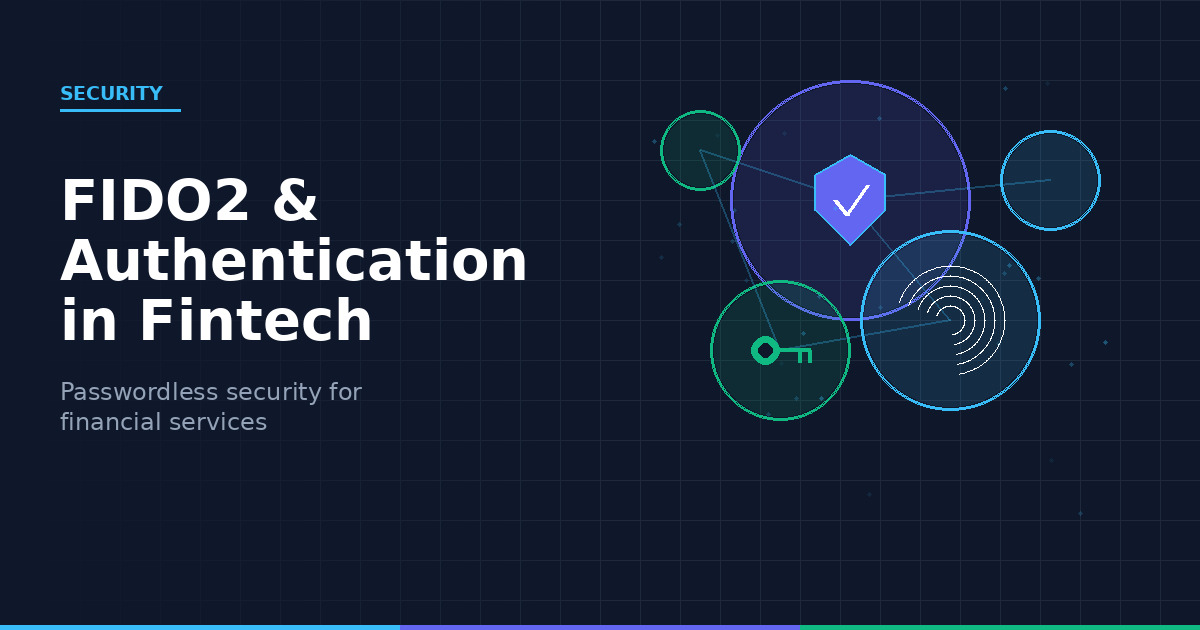
FIDO2 and Modern Authentication Methods in Fintech
As fintech platforms handle increasingly sensitive financial data, the authentication methods protecting them must evolve. FIDO2, biometrics, and passwordless authentication are reshaping how financial services verify identity—offering stronger security without sacrificing user experience.
The Problem with Passwords in Finance
Passwords remain the weakest link in financial services security. Despite decades of "best practices"—minimum lengths, special characters, rotation policies—credential-based attacks continue to dominate breach reports. In fintech, the stakes are higher: a compromised account means direct access to money.
Phishing attacks targeting financial services grew 61% in 2025, with credential stuffing and social engineering accounting for the majority of unauthorised access incidents. The industry needs authentication that is resistant to these attacks by design, not by policy.
What Is FIDO2?
FIDO2 is an open authentication standard developed by the FIDO Alliance and the W3C. It consists of two components: WebAuthn (the browser API) and CTAP2 (the protocol for communicating with hardware authenticators). Together, they enable passwordless, phishing-resistant authentication.
The core principle is simple: instead of sharing a secret (password) with a server, the user proves possession of a private key stored on their device. The server only ever sees the public key, so there is nothing valuable to steal in a data breach.
// WebAuthn registration flow (simplified)
const credential = await navigator.credentials.create({
    publicKey: {
        challenge: serverChallenge,
        rp: { name: "Acme Financial", id: "acmefinancial.com" },
        user: {
            id: userId,
            name: "user@example.com",
            displayName: "Jane Smith"
        },
        pubKeyCredParams: [
            { alg: -7, type: "public-key" },   // ES256
            { alg: -257, type: "public-key" }   // RS256
        ],
        authenticatorSelection: {
            authenticatorAttachment: "platform",
            userVerification: "required"
        }
    }
});

// Send credential.response to server for verification and storage
Why FIDO2 Matters for Fintech
FIDO2 addresses several critical requirements that are specific to financial services:
- Phishing resistance: Credentials are cryptographically bound to the origin (domain). A phishing site on a lookalike domain simply cannot trigger authentication—the browser enforces this at the protocol level.
- PSD2/SCA compliance: FIDO2 inherently satisfies Strong Customer Authentication requirements by combining possession (the device) with inherence (biometric) or knowledge (PIN), meeting the two-factor mandate without additional friction.
- No shared secrets: Unlike passwords or even TOTP seeds, the private key never leaves the authenticator device. A server-side breach exposes only public keys, which are useless to attackers.
- Regulatory alignment: The FCA and EBA increasingly recognise FIDO2 as a compliant authentication method, and its phishing resistance aligns with operational resilience expectations.
Passkeys: FIDO2 for the Masses
Passkeys represent the consumer-friendly evolution of FIDO2. Backed by Apple, Google, and Microsoft, passkeys synchronise FIDO2 credentials across devices via cloud keychains. For fintech applications, this solves the device-binding problem—users can authenticate on a new device without re-enrolling.
However, passkeys introduce considerations that fintech platforms must evaluate carefully. Synchronised credentials mean the security posture is partly dependent on the user's cloud account security. For high-value transactions, platforms may choose to require device-bound keys (non-synced) rather than synced passkeys.
Comparing Authentication Methods
No single authentication method fits all fintech use cases. The right approach depends on the risk profile of the action being performed:
| Method | Phishing Resistant | PSD2/SCA Compliant | User Experience | Best For |
|---|---|---|---|---|
| FIDO2 / Passkeys | Yes | Yes | Excellent | Primary authentication, high-value transactions |
| SMS OTP | No | Partially | Good | Legacy fallback only—vulnerable to SIM swap |
| TOTP (Authenticator Apps) | No | Yes | Moderate | Second factor where FIDO2 is unavailable |
| Push Notifications | Partial | Yes | Good | Transaction approval, step-up authentication |
| Biometrics (Device) | Yes (with FIDO2) | Yes | Excellent | Mobile app login, payment confirmation |
| Hardware Tokens | Yes | Yes | Poor | Admin access, treasury operations |
Adaptive Authentication in Practice
Modern fintech platforms should implement adaptive (risk-based) authentication that adjusts the required assurance level based on context. A balance check from a recognised device might require only a passkey tap, while a large outbound transfer triggers step-up authentication with a hardware token.
Key signals for risk scoring include:
- Device fingerprint and trust level
- Geolocation and IP reputation
- Transaction amount and velocity
- Behavioural biometrics (typing patterns, navigation habits)
- Time of day and session duration
This layered approach satisfies regulatory requirements while keeping low-risk interactions frictionless—critical for customer retention in competitive fintech markets.
Implementation Considerations
Rolling out FIDO2 in a regulated fintech environment requires planning beyond the technical integration:
- Fallback flows: Not all users will have FIDO2-capable devices. Design graceful degradation paths that maintain security without excluding customers.
- Account recovery: Passwordless authentication shifts the recovery problem. Pre-registered backup keys, verified identity re-proofing, or recovery codes stored offline must be considered.
- Audit trails: Regulators expect detailed authentication logs. Capture the authenticator type, assurance level, and risk signals for every authentication event.
- Key lifecycle: Define policies for credential rotation, revocation, and the maximum number of registered authenticators per account.
Conclusion
The fintech industry is at an inflection point for authentication. FIDO2 and passkeys offer a genuinely phishing-resistant, user-friendly alternative to passwords—and regulators are taking notice. The firms that adopt these standards now will be better positioned for upcoming regulatory changes while delivering a superior customer experience. The question is no longer whether to adopt passwordless authentication, but how quickly you can get there.