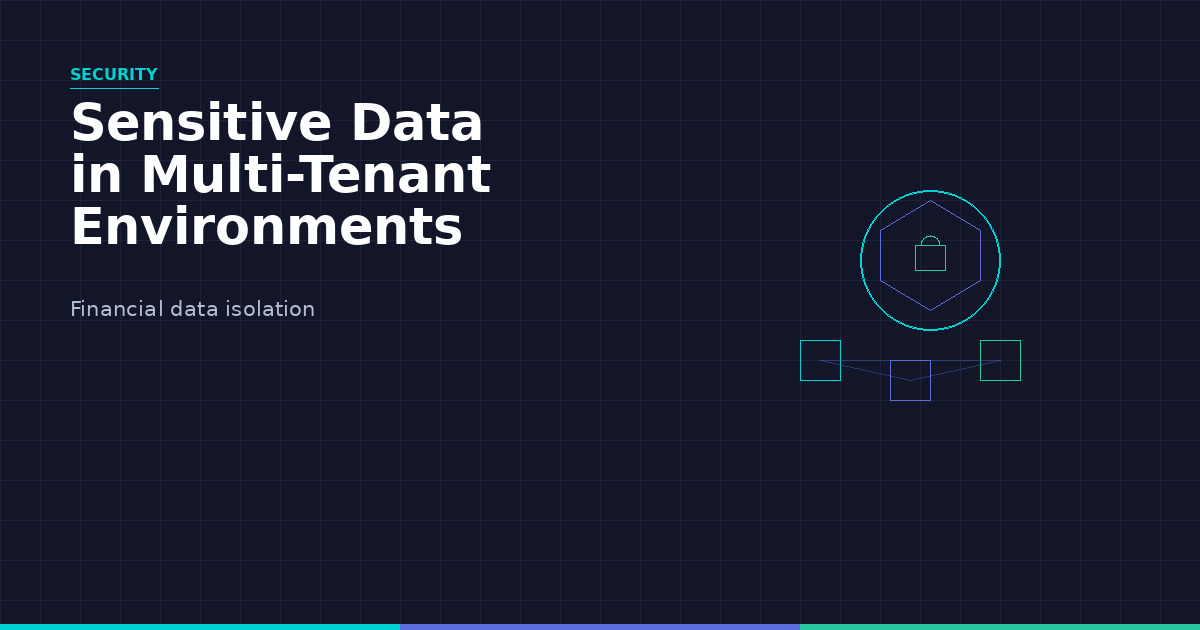
Handling Sensitive Financial Data in Multi-Tenant Environments
We inherited a platform once where a single missing WHERE clause in a dashboard query had been silently showing Tenant A fragments of Tenant B's transaction summaries for three months. Nobody noticed because the numbers looked plausible. The breach was discovered during a routine demo when the client's CFO said "I don't recognise that merchant name."
That's the nightmare scenario with multi-tenant financial platforms. Not a dramatic hack. A quiet, plausible data leak that looks like normal data until someone squints.
Multi-tenancy is the default for modern SaaS. One codebase, shared infrastructure, many customers. For most software, the consequences of a tenant isolation failure are embarrassing. For financial services, they're reportable.
Why financial data changes the calculus
When your platform holds payment records, bank account numbers, transaction histories, and cash positions for multiple clients, a cross-tenant data leak is not a bug. It's a breach under GDPR and most financial services regulations. Your client's legal team gets involved. Your client's regulator gets involved. The remediation isn't a patch — it's an incident report, a forensic audit, and possibly a public disclosure.
The risk isn't proportional to the sensitivity of the leaked data. It's binary. Any cross-tenant exposure of financial records — even a transaction count, even a merchant name — triggers the same compliance machinery.
This asymmetry between "how bad the bug feels" and "how bad the consequences are" is what makes multi-tenant financial platforms architecturally different from multi-tenant project management tools.
The decision we keep making (and why)
We default to separate databases per tenant for financial platforms. Not because it's the only way, but because it eliminates an entire category of bug.
With shared tables and a tenant_id column, every query, every API endpoint, every report, every cache key, every webhook payload, every background job must correctly scope to the right tenant. You're trusting your application code — every line of it, written by every developer, reviewed under every deadline — to never forget the filter.
With separate databases, the connection string is resolved per tenant before any query runs. A query against Tenant A's database cannot return Tenant B's data. Not because the code is correct, but because the data physically isn't there.
The engineering trade-off is real: more databases to provision, more migrations to run, more backups to manage, more monitoring to configure. We've built the tooling to automate this, and the operational overhead is predictable and linear. The alternative — trusting application-level isolation for financial data — is an operational risk that's unpredictable and catastrophic.
We've seen teams choose shared-database multi-tenancy for financial platforms to save on infrastructure costs. The infrastructure savings are real. The first cross-tenant incident costs more than a decade of separate database hosting.
The layers that matter beyond the database
Separate databases solve storage isolation. But data moves through your system in more places than the database.
Caches
A Redis key that stores "latest_balance_account_123" without a tenant prefix will serve stale — or wrong — data if two tenants have an account with ID 123. Every cache key must be tenant-scoped. We prefix every key with the tenant identifier. No exceptions, no "performance optimisation" that strips the prefix.
We had an incident early on — not on a client system, on our own staging environment — where a cache key collision between two test tenants returned the wrong balance for fifteen minutes. In staging, that's a debugging session. In production, that's a CFO seeing the wrong number and losing trust in the platform permanently.
Background jobs
A scheduled reconciliation job that pulls "all unmatched transactions" without scoping to a tenant will process every tenant's data in a single run. Best case: performance degradation. Worst case: a reconciliation report that mixes two clients' transactions.
Every background job receives the tenant context at dispatch time. The job validates it before processing. If the tenant context is missing, the job fails loudly. Not silently. Not with a fallback to "default tenant." It fails, it alerts, and someone investigates.
Logs and error reporting
Application logs that include transaction details, amounts, or references must be tenant-aware. A developer debugging an issue in Sentry or Datadog should not be able to see Tenant B's transaction data while investigating Tenant A's error.
In practice: structured logging with tenant_id as a filterable field, access controls on log platforms scoped by tenant, and a policy that raw financial data (account numbers, amounts) is masked in logs unless explicitly needed for investigation.
API responses
Every API endpoint validates that the authenticated user has access to the requested resource's tenant. This sounds obvious. But in practice, it means:
- A GET request for
/transactions/12345doesn't just check that the transaction exists. It checks that the requesting user's tenant owns it. - A list endpoint doesn't just paginate results. It filters by tenant before paginating.
- An aggregation endpoint (total volume, average settlement time) computes exclusively from the requesting tenant's data.
We've reviewed platforms where the API correctly filtered list endpoints but forgot to filter detail endpoints. The list showed only your transactions, but if you guessed a transaction ID, you could fetch anyone's.
What clients actually ask
Before signing, financial services clients will probe your data handling. After years of these conversations, here's what separates "we'll get back to you" from "yes, here's how":
"Show me the isolation model." Not describe it — show it. Architecture diagram, database topology, tenant resolution flow. If you can draw it on a whiteboard in five minutes, you understand it. If you need to "check with engineering," you don't.
"What happens during a deployment?" Migrations run per tenant database. A failed migration on Tenant A doesn't affect Tenant B. Deployments are tenant-aware. If a deployment breaks Tenant A, Tenant B is unaffected. If you can't demonstrate this, your isolation is thinner than you think.
"Can you produce an access log for our data?" Every access — application, developer, admin, automated — logged with timestamp, user identity, action, and affected records. Producible within 24 hours of request. This isn't a feature you add later. It's infrastructure you build on day one.
"What happens when we leave?" Data deletion: primary database dropped, backups expired on schedule, cached data invalidated, references removed from shared systems (logging, monitoring). Certified in writing. If you can't prove the data is gone — including from backups — you haven't deleted it.
"If another tenant is breached, what's the impact on us?" With separate databases: none. The compromised tenant's data is in a different database, accessed through different credentials, stored in different encryption scope. There is no lateral path. This is the conversation that justifies the separate-database approach. With shared tables, the honest answer is "it depends on the nature of the breach" — and that answer does not close deals.
The compliance surface
Different jurisdictions, different rules, same principle: know where the data is and control who touches it.
Data residency: some clients require data to stay in-country. With separate databases, this is a configuration choice per tenant — spin up the database in the required region. With shared tables, you're either sharding by region (complex) or storing everyone's data in every region (expensive and possibly non-compliant).
Retention and deletion: different clients have different retention requirements. Tenant A needs 7 years, Tenant B needs 5. With separate databases, retention policies are per-database. With shared tables, you're running tenant-specific deletion jobs against shared data — which is exactly the kind of operation that goes wrong.
Breach notification: under GDPR (72 hours) and most financial regulations, you need to know which tenants are affected and what data was exposed. With separate databases, a breach of one database affects one tenant. With shared tables, a breach of the database affects all tenants — and your notification obligation covers all of them.
The honest trade-off
Separate databases are not free. They cost more to operate. They make some cross-tenant analytics harder (though for financial platforms, cross-tenant analytics are usually prohibited anyway). They add operational complexity that needs tooling and automation.
But the cost is predictable, linear, and manageable. The cost of a cross-tenant data breach in financial services is unpredictable, non-linear, and potentially existential.
We've made this trade-off enough times to be confident in it. Not because we're paranoid — because we've seen what happens when the cheaper approach fails, and we'd rather not be in that room again.
Zenlime builds financial platforms with tenant isolation designed to survive audit scrutiny. Start a conversation.